log.j38.uk

Hello World

This blog is a place for me to place quotations, notes, thoughts, photos.

How to navigate

  • Hit ? to see keyboard shortcuts.
  • Filters at the top toggle posts on and off.

What to expect

Some rather disparate content appears here as I have degrees and retain interest in Computer Science as well as Greek & Latin classics with a healthy dose of philosophy.

Testing out the new daily flow. Did it werk?

Philosophy is the science of Life. Its problem is to find the Ultimate from which we may explain the origin of man and nature, determine the laws of their growth, obtain a presentiment of their destiny, and become inspired with a pure and noble zeal to live and die for the glory of God, and the progress of mankind.

There is and can be no higher problem than this, none more worthy to engage the whole force of our minds and our hearts. It is the problem of problems; it includes all other problems; and on its solution depend all other problems for theirs. We have answered no question, whether of man or nature, of society, religion, or morals, till we have traced it to the Ultimate, beyond which there is no question to be asked, or to be answered.

But the Ultimate for ever escapes us. It recedes always in proportion as we advance; and is never seized save in a finite and relative form. The complete solution, therefore, transcends, and for ever must transcend, the reach of our powers. All that we can do, and all that we should attempt, is to obtain the solution that shall meet the wants and satisfy the heart of our own epoch. This solution, though it must one day needs be outgrown, as we outgrow the garments of our childhood, will, nevertheless, bring us a measure of peace, become the point of departure for new inquirers, and pave the way for new and more adequate solutions.

Orestes Brownson. "Synthetic Philosophy"

It is easy to lie with statistics, but easier to lie without them.

Frederick Mosteller

I've wondered for a time how formal verification e.g with Lean might turn out production code. One way, used at AWS, is through differential testing. Prototype the software in the verification language, and then use the formally proved code as the prototype / spec for the production code. Next, run identical tests against the prototype and the production code. This at least proves that the production code behaves (within set variances) exactly like the proved-to-be-correct prototype does.

"Mercantilist policies" are those which seek to bolster the nation-state, esp. by exporting as many goods as possible while importing as few as possible.

Just as a programming language can be considered a virtual computer, that is, a computer implemented in software, so a computer can be considered a programming language implemented in hardware.

Maclennon, Principles of Programming Languages


There are many ways to import modules with ESM. Some ways allow for testing frameworks to intercept and mock methods from these modules, while others do not.

Two methods I use most often are:

// named imports (destructured into method names}
import { fnUsedAsReal, fnToBeMocked } from "file.ts";

and

// namespace import (or star-import)
import * as File1Module from "./file.ts";

Namespace imports are required for vitest to be able to spy/mock dynamically.

vi.spyOn(File1Module, "fnToBeMocked").mockResolvedValue(["123123", "123124", "123125"]);

The biggest gotcha I've found in upgrading from jest to vitest is that if any of the mocked methods are called internally within its own module, the mock does not work. e.g.

You have a test in file.test.ts. It imports all methods from file.service.ts -> import * as MyService from 'file.service.ts'; You mock a method function1 so you can test it... but inside file.service.ts there are references/calls to function1, the mock will not work.

The workaround is simply to move anything that has to be mocked to its own file. iow for the example above, both the test file and the service file will import function1 from a third file, and the mock will work. This, in my case, is mostly fine as the internal calls are almost all to database functions that make sense to be organized into their own file anyway.


In machine learning, the "learning" term is effectively a "cost minimizing" calculus function.

(Probably a quotation from 3Blue1Brown but I don't recall)

Qui plantávit aurem, non áudiet? * aut qui finxit óculum, non consíderat?

"Is there, in all republics, this inherent, and fatal weakness? Must a government, of necessity, be too strong for the liberties of its own people, or too weak to maintain its own existence?"

Abraham Lincoln (July 4 1861)

nomen ergo est vox significitiva

A monk found another smoking while saying the Rosary. "Did the abbot give you permission to do that?" he asked. "Yes," replied the second monk. The first monk was upset. "Then why did the abbot say no to me when I asked him the same question?" "What did you ask him?" said the first monk. "I asked him if it was all right to smoke while I prayed." "Oh," said the second monk, "That explains it. I asked him if it was all right to pray while I smoked."

Kreeft, Socratic Logic 99


Inest enim homini naturale desiderium cognoscendi causam, cum intuetur effectum; et ex hoc admiratio in hominibus consurgit. Si igitur intellectus rationalis creaturae pertingere non possit ad primam causam rerum, remanebit inane desiderium naturae. Unde simpliciter concedendum est quod beati Dei essentiam videant.

Summa Theologica I, q. 12, a. 1

The preference for signals vs state driven rendering make good sense. But it seems that the advances coming with React Compiler give us the same advantages without new libraries or code changes (i.e. automatic memoization and avoiding unnecessary rendering in parts of tree where no state is accessed).

The philosopher today is therefore pressed, and simply by reason of his objective social role in the community, into an imitation of the scientist: he too seeks to perfect the weapons of his knowledge through specialization. Hence the extraordinary preoccupation with technique among modern philosophers, with logical and linguistic analysis, syntax and semantics; and in general with the refining away of all content for the sake of formal subtlety. The movement known as Logical Positivism, in this country (the atmosphere of humanism is probably more dominant in the European universities than here in the United States), actually trafficked upon the guilt philosophers felt at not being scientists; that is, at not being researchers producing reliable knowledge in the mode of science. The natural insecurity of philosophers, which in any case lies at the core of their whole uncertain enterprise, was here aggravated beyond measure by the insistence that they transform themselves into scientists.

Barret, Irrational Man 6

The term for the idea that AI could improve itself indefinitely is "recursive self-improvement" or RSI.

A related term for technology having achieved RSI is "Artificial General Intelligence" or AGI.

RSI's impossibility stems from epistemological limits (no self-bootstrapping without grounding), computational bounds (diminishing returns, uncomputability), and philosophical subjectivity ("improvement" as human-relative, not machine-quantifiable). For instance, if "the good" is an abstraction requiring nuanced values, pure recursion can't capture it without human-like qualia or external input.

Related reading: The Illusion of Self-Improvement: Why AI Can’t Think Its Way to Genius

Science may be described as the art of systematic oversimplification.

Karl Popper


Since the building of all the universe is perfect and is created by the wisdom creator, nothing arises in the universe in which one cannot see the sense of some maximum or minimum.

L. Euler

Authentication proves who you are (usually by means of some password or token). Authorization proves what you can do. An http 401 error is for the former and an http 403 is for the latter. Note the confusion of terms. http 401s are named Unauthorized while they really mean not authenticated.

The understanding, like the eye, whilst it makes us see and perceive all other things, takes no notice of itself; and it requires art and pains to set it at a distance, and make it its own object.

Locke

The great benefit of computer sequencers is that they remove the issue of skill, and replace it with the issue of judgement. With Cubase or Photoshop, anybody can actually do anything, and you can make stuff that sounds very much like stuff you’d hear on the radio, or looks very much like anything you see in magazines. So the question becomes not whether you can do it or not, because any drudge can do it if they’re prepared to sit in front of the computer for a few days, the question then is, ‘Of all the things you can now do, which do you choose to do?‘

Brian Eno via this blog post connecting the thought to AI

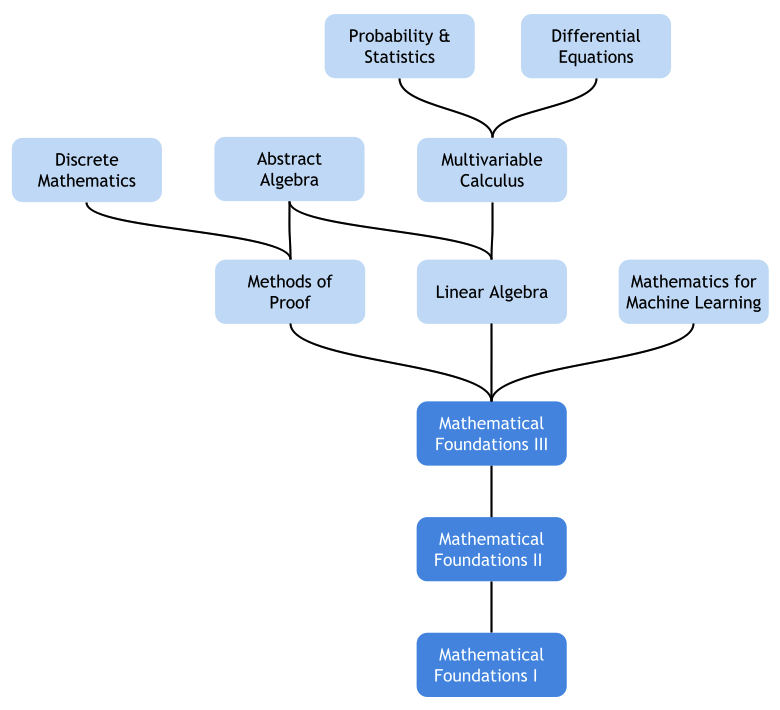
I have been doing Math Academy lessons for a couple weeks now. I tested into Foundations I at about 80% complete so will be done with that course in a couple more weeks. I suppose a whole course could take me about 6 months. So I probably have a few years of work ahead if I go the route of Foundations II and III, then Methods of Proof, then Discrete Mathetmatics. (Or another path to ML or Probability and Statistics... img. The gamification, repetition on the student's weak areas, and "dependency tree" for the order of learning are impressive. I'll re-evalautae a few months later, but I could see this being a better way to learn than the classroom setting simply because it's so targeted at the individual's weaknesses (and still exercises the strengths as well). On the flip side, nothing can replace learning through dialogue - dialogue which is allowed to meander to and from related ideas. If I had to design a Math class today I'd think MA could be the basis of homework/exercises which some kind of face-to-face Q&A or seminar or traditional lessons at a certain frequency. Still, for me, it's a perfect way to get some schooling in the gaps of my day.


TIL about csvkit which has a number of CLI tools for working with CSVs. The cool thing I'm after is csvjoin which merges two CSVs on a common column (like a sql join).

I am active in as true and high a sense in my unconscious operations, as in what are properly called my volitions. If this were not so, moral character could attach only to those acts which are performed after deliberation, which is not true. The real moral character of the man is determined, almost solely, by his spontaneous operations, the unconscious motions of his soul.

Brownson

Today I:

  • Fixed my led light on my microphone mute button (which caused me all kinds of confusion during meetings)
  • Added wluma to serve mainly as a reminder that my privacy shutter is open [edit] I removed wluma several days later because it wasn't very good. Brightness levels jumped all over the place and app window switching slowed because it spiked in CPU usage for window switching.

Today I am trying out the Cookie Store API which is a relatively new addition to browsers. It's quite easy to use and has some slick features like the ability to subscribe to changes on the cookie. Am presently having trouble with storing a cookie that has semi-colons so either have to encode or find a new delimiter for the thing I'm storing.

Today I'm thinking about a "coding standards" document and what should be included in it. Linters cover most rules except for casing... scratch that, eslint has a calcase rule. I like to case database tables and fields one way (snake_case), code a different way (often camelCase but depends on the language), and th there's also things like url parameters other things that should follow a consistent pattern. Other topics (brainstorming here) to include are DRY (more and less), file size, logging patterns, commenting (or lack thereof), error handling, uri testing, code coverage standards. I'll be thinking of more later. Some of these things can be enforced with Draconian linter policies, but I tend to like to put just the big things in linter rules (e.g. no unused variables) and leave at least a little creative freedom to the devs. It's fun to be able to look at code and know who wrote it without looking at git history/blame to find out - since the mark/style of a human remains.

Using niri as a standalone wayland wm on nixOS presents a few challenges (and benefits) since there is no full fledged desktop environment that it's beholden to (you can more easily choose any tool rather than the one for your desktop env) or can take advantage of (there's no obvious tool to choose). IOW it can be good because one is not 'tied into' anything, but can be bad (esp. for the overly analytical types like myself) because it can take some time to choose everything from the ground up. e.g. much of what I'm using is terminal based rather than point and click. I'm using bluetuith for bluetooth, nmtui for wifi connecting, fuzzel + bash scripts for app launching, various tools for pipewire audio. Mostly everything works great, and for those with the DIY linux spirit, it's worth the time.

The attempt at building niri for development got me reading a Rust book...

the Rust programming language is fundamentally about empowerment: no matter what kind of code you are writing now, Rust empowers you to reach farther, to program with confidence in a wider variety of domains than you did before.

Rust isn’t limited to low-level systems programming. It’s expressive and ergonomic enough to make CLI apps, web servers, and many other kinds of code quite pleasant to write


On the topic of 'infrastructure as code' there arises the organizational question of whether to put everything in one repository (e.g. all the infrastructure for any app) or to divvy it up into the individual app repos. There will always be overlap and interdependencies so there's no easy answer. Some like to deploy infrastructure changes along with the code and so the latter method is good for that. That worries me because there are more variables in flux. I'd rather have rollouts of infrastructure changes generally go out in advance (unless there's some reason it can't) of application changes. And so the former (all in one repo) is my preference.


One thing I haven't found for Linux is a good 'random unicode symbol' entry system. On OSX I could easily use key combos (built-in) for the semi-weird characters (like bullets) and then pull up an "emoji/special characters" window that let me select the even weirder characters.

The attempt at building niri for development got me reading a Rust book...

the Rust programming language is fundamentally about empowerment: no matter what kind of code you are writing now, Rust empowers you to reach farther, to program with confidence in a wider variety of domains than you did before.

Rust isn’t limited to low-level systems programming. It’s expressive and ergonomic enough to make CLI apps, web servers, and many other kinds of code quite pleasant to write


On the topic of 'infrastructure as code' there arises the organizational question of whether to put everything in one repository (e.g. all the infrastructure for any app) or to divvy it up into the individual app repos. There will always be overlap and interdependencies so there's no easy answer. Some like to deploy infrastructure changes along with the code and so the latter method is good for that. That worries me because there are more variables in flux. I'd rather have rollouts of infrastructure changes generally go out in advance (unless there's some reason it can't) of application changes. And so the former (all in one repo) is my preference.


One thing I haven't found for Linux is a good 'random unicode symbol' entry system. On OSX I could easily use key combos (built-in) for the semi-weird characters (like bullets) and then pull up an "emoji/special characters" window that let me select the even weirder characters.

In citations to the Summa, c. => contra and co. => corpus. The contra is the short sed contra est (On the contrary) section after the opening objections. The corpus is the respondeo dicendum (I answer that) section where St. Thomas elaborates his answer.

in ipsa, forma non est potentia ad non esse I, q.9, a.2, co.

Increasingly over the last maybe forty years, the thought has come to me that the old world in which our people lived by the work of their hands, close to weather and earth, plants and animals was the true world; and that the new world of cheap energy and ever cheaper money, honored greed, and dreams of liberation from every restraint, is mostly theater. This new world seems a jumble of scenery and props never quite believable, an economy of fantasies and moods, in which it is hard to remember either the timely world of nature or the eternal world of the prophets and poets.

Wendell Berry. Andy Catlett: Early Travels. Shoemaker & Hoard, 2006. p. 93

The threat to domestic tranquility is not that people take sides and disagree, but that the sides of a political division will assume the purity and passion of moral absolutism or moral allegory, in which the people on each side think of themselves as Good and of the people on the other side as Evil. The passions on both sides then are reduced to mere anger, fear, and hatred. A society with an absurdly attenuated sense of sin starts talking then of civil war or holy war, and trending toward the psychology of the battlefield. So absolute a division forbids actual thought or discourse about moral issues, as it forbids self-knowledge, humor, and forgiveness. It may be that such division is prepared by our convention of two political parties. It may be that actual thought about a problem requires more than two opinions.

Wendell Berry, The Need to be Whole, 188-9.

Obviously, we can work on a gigantic scale, but just as obviously we cannot foresee the gigantic catastrophes to which gigantic works are vulnerable, any more than we can foresee the natural and human consequences of such work. We can develop a global economy, but only on the conditions that it will not be loving in its effects on its human and natural sources, and that it will risk global economic collapse.

Wendell Berry, “Two Minds” in Citizenship Papers, 104-5.

If people do not believe that mathematics is simple, it is only because they do not realize how complicated life is.

John von Neumann

Plato tells us with all clarity that his philosophy demands the whole human being. Intellectual capability alone is insufficient; what is required is an inner relationship between the thing which is to be conveyed and the soul to which it is to be conveyed. Anybody who is not prepared to enter upon a process of inner transformation is not entitled to know the full solution either.

Thomas A. Szlezák, Reading Plato.

What has been called St. Thomas's "system" took shape in this work of assembling, sifting, ordering. The body of knowledge of his time became ordered in his mind. He wrote no "philosophical system," nor has the system behind his works been written so far.

Yet anyone who studies his works will find clear, definite answers, perhaps to more questions than he himself could ask. And what is more, the organon that the Master bore within himself and that enabled him to settle a host of issues with a firm, serene respondeo dicendum, leaves its mark on his "disciple" and gives him the ability to answer questions in Thomas's spirit that Thomas never asked and possibly at that time could not have been asked at all.

This may well also be the reason why folks today are going back to his writings. Ours is a time that is no longer content with methodical deliberations. People have nothing to hold on to and are looking for purchase. They want a truth to cling to, a meaning for their lives; they want a "philosophy for life." And this they find in Thomas.

Of course there is a difference between Thomas's philosophy and what passes for "philosophy for life" today. In his philosophy we will look in vain for flights of emotion; all we will find is truth, soberly grasped in abstract concepts. On the surface much of it looks like theoretical "hairsplitting" that we cannot "do" anything with. And even after serious study it is not easy to put our finger on practical returns.

But a person who has lived for some time with the mind of St. Thomas – lucid, keen, calm, cautious – and dwelt in his world, will come to feel more and more that he is making right choices with ease and confidence on difficult theoretical issues or in practical situations where before he would have been helpless. And if later he thinks back – even surprising himself – on how he managed it, he will realize that a bit of Thomas's "hairsplitting" laid the groundwork. At the time that Thomas was working on this or that problem, he naturally had no idea what it could someday be "good for," nor was he concerned about it. He was but following otu the law of truth; truth bears fruit of itself.

St. Edith Stein. Knowledge and Faith. tr. Walter Redmond. ICS Publications. 2000. pp.26-28

Many are the wonders, none
is more wonderful than what is man.
This it is that crosses the sea
with the south winds storming and the waves swelling,
breaking around him in roaring surf.
He it is again who wears away
the Earth, oldest of gods, immortal, unwearied,
as the ploughs wind across her from year to year
when he works her with the breed that comes from horses.
The tribe of the lighthearted birds he snares
and takes prisoner the races of savage beasts
and the brood of the fish of the sea,
with the close-spun web of nets.
A cunning fellow is man. His contrivances
make him master of beasts of the field
and those that move in the mountains.
So he brings the horse with the shaggy neck
to bend underneath the yoke;
and also the untamed mountain bull·
and speech and winds wift thought
and the tempers that go with city living
he has taught himself, and how to avoid
the sharp frost, when lodging is cold
under the open sky
and pelting strokes of the rain.
He has a way against everything,
and he faces nothing that is to come
without contrivance.
Only against death
can he call on no means of escape;
but escape from hopeless diseases
he has found in the depths of his mind.
With some sort of cunning, inventive
beyond all expectation
he reaches sometimes evil
and sometimes good.
If he honors the laws of earth,
and the justice of the gods he has confirmed by oath,
high is his city; no city
has he with whom dwells his honor
prompted by recklessness.
He who is so, may he never
share my hearth!
may he never think my thoughts!

Sophocles, Antigone 332-75. (tr. Lattimore)

Everything becomes hateful when a man abandons his own nature and acts at variance with it.

ἅπαντα δυσχέρεια, τὴν αὑτοῦ φύσιν / ὅταν λιπών τις δρᾷ τὰ μὴ προσεικότα.

Sophocles, Philoctetes 902.

It is impossible to know any man–I mean his soul, intelligence, and judgement–until he shows his skill in rule and law.

ἀήχανον δὲ παντὸς ἀνδρὸς ἐκμαθεῖν / ψυχήν τε καὶ φρόνημα καὶ γνώμην, πρὶν ἂν / ἀρχαῖς τε καὶ νόμοισιν ἐντριβὴς φανῇ.

Sophocles, Antigone 175-7 (tr. Lattimore).

What about the main thing in life, all its riddles? If you want, I'll spell it out for you right now. Do not pursue what is illusionary — property and position: all that is gained at the expense of your nerves decade after decade, and is confiscated in one fell night. Live with a steady superiority over life — don't be afraid of misfortune, and do not yearn for happiness; it is, after all, all the same: the bitter doesn't last forever, and the sweet never fills the cup to overflowing…

Aleksandr Solzhenitsyn, The Gulag Archipelago. Vol 1, 591-2.

Not everything assumes a name. Some things lead beyond words.

Aleksandr Solzhenitsyn

But the fundamental, intrinsic reason for culture’s ongoing decline, its petering out, is its secularization. For several centuries now, the minds of enlightened humanity have been increasingly captivated by anthropocentrism—more politely called humanism—which in the twentieth century risked morphing almost into totalitarianism. But a hubristic anthropocentrism can provide no answers to many of life’s vital questions, and the deeper these questions, the more helpless it appears. The spiritual component is being expunged ever more perniciously from the system of human conceptions and motivations. As a result, our entire structure of values, our understanding of man’s very nature and mission in life, has become distorted. Little by little, we’ve fallen out of sync with the rhythm and breath of Nature, of the Universe.

Aleksandr Solzhenitsyn, “The depletion of culture” §

Ideology-that is what gives evildoing its long-sought justification and gives the evildoer the necessary steadfastness and determination. That is the social theory which helps to make his acts seem good instead of bad in his own and others’ eyes, so that he won’t hear reproaches and curses but will receive praise and honors. That was how the agents of the Inquisition fortified their wills: by invoking Christianity; the conquerors of foreign lands, by extolling the grandeur of their Motherland; the colonizers, by civilization; the Nazis, by race; and the Jacobins (early and late), by equality, brotherhood, and the happiness of future generations. Thanks to ideology, the twentieth century was fated to experience evildoing on a scale calculated in the millions. This cannot be denied, nor passed over, nor suppressed. How, then, do we dare insist that evildoers do not exist? And who was it that destroyed these millions? Without evildoers there would have been no Archipelago.

Solzhenitsyn (Trans. Whitney). The Gulag Archipelago. Harper & Row.

Try to crack the nut yourself; it will hurt your hands, but it will break, and St. Thomas himself will instruct his pupil. For this end, as you read each article, consult carefully the different passages to which the editions refer you; consult the Index Tertius, an imperfect treasure, but a treasure all the same; compare text with text; make the different sources of information complete and illustrate one another, and draw up your own article. It is an excellent gymnastic, which will give your mind flexibility, vigor, precision, breadth, hatred of sophistry and of inexactitude, and at the same time insure you a progressively increasing store of notions that will be clear, deep, consecutive, always linked up with their first principles and forming by their interadaptation a sound synthesis.

Sertillanges (on the exercise of composing articles like those of St. Thomas)

If it is art, it is not for all and if it is for all, it is not art.

Arnold Schoenberg

The great art therefore of piety, and the end for which all the rites of religion seem to be instituted, is the perpetual renovation of the motives to virtue, by a voluntary employment of our mind in the contemplation of its excellence, its importance, and its necessity, which, in proportion as they are more frequently and more willingly revolved, gain a more forcible and permanent influence, till in time they become the reigning ideas, the standing principles of action, and the test by which every thing pro­posed to the judgment is rejected or approved.

To facilitate this change of our affections, it is necessary that we weaken the temptations of the world, by retiring at certain seasons from it; for its influence, arising only from its presence, is much lessened when it becomes the object of solitary meditation. A constant residence amidst noise and pleasure, inevitably obliterates the impressions of piety, and a frequent abstraction of ourselves into a state, where this life, like the next, operates only upon the reason, will reinstate religion, in its just authority, even without those irradiations from above, the hope of which I have no intention to withdraw from the sincere and the diligent.

This is that conquest of the world and of ourselves, which has been always considered as the perfection of human nature; and this is only to be obtained by fervent prayer, steady resolutions, and frequent retirement from folly and vanity, from the cares of avarice, and the joys of intemperance, from the lulling sounds of deceitful flattery, and the tempting sight of prosperous wickedness.

Samuel Johnson, Rambler 6

He who has so little knowledge of human nature, as to seek happiness by changing any thing but his own dis­positions, will waste his life in fruitless efforts, and multiply the griefs which he purposes to remove.

Samuel Johnson, Rambler 6

Conversation is more fruitful than lectures.

Here, so he boasts, many an hour of personal conversation with the learned philologians was more instrucive and stimulating than an entire week of classes.

Hier brachte ihm, wie er rühmte, manche Stunde persönlicher Unterhaltung mit dem gelehrten Philologen mehr Belehrung und Anregung als eine ganze Woche Unterricht.

Otto Ribbeck, Friedrich Wilhelm Ritschl (1879) 12.

Many blogs begin with a post on why the blog will be blogged. This blog, however, is, so far, an amalgamation of quotations and passages that I had collected from many places and probably had on a few blogs before. (I am still moving content from those places over here.) I would also like to start writing a little. My main goal will be to clarify my own thinking, for myself. But putting such things on a public platform will help me to care about spelling and clarity a bit more than otherwise. That is why this blog will be blogged.

At first, when God is left out of the picture, everything apparently goes on as before. Mature decisions and the basic structures of life remain in place, even though they have lost their foundations. But, as Nietzsche describes it, once the news really reaches people that "God is dead" and they take it to heart, then everything changes. This is demonstrated today, on the one hand, in the way that science treats human life: man is becoming a technological object while vanishing to an ever greater degree as a human subject, and he has only himself to blame. When human embryos are artificially "cultivated" so as to have "research material" and to obtain a supply of organs, which then are supposed to benefit other human beings, there is scarcely an outcry, because so few are horrified any more. Progress demands all this, and they really are noble goals: improving the quality of life at least for those who can afford to have recourse to such services. But if man, in his origin and at his very roots, is only an object to himself, if he is "produced" and comes off the production line with selected features and accessories, what on earth is man then supposed to think of man? How should he act toward him? What will be man's attitude toward man when he can no longer find anything of the divine mystery in the other, but only his own know-how? What is happening in the "high-tech" areas of science is reflected wherever the culture, broadly speaking, has managed to tear God out of men's hearts. Today there are places where trafficking in human beings goes on quite openly: a cynical consumption of humanity while society looks on helplessly. For example, organized crime constantly brings women out of Albania on various pretexts and delivers them to the mainland across the sea as prostitutes, and because there are enough cynics there waiting for such "wares", organized crime becomes more powerful, and those who try to put a stop to it discover that the Hydra of evil keeps growing new heads, no matter how many they may cut off. And do we not see everywhere around us, in seemingly orderly neighborhoods, an increase in vio-lence, which is taken more and more for granted and is becoming more and more reckless? I do not want to extend this horror-scenario any farther. But we ought to wonder whether God might not in fact be the genuine reality, the basic prerequisite for any "realism", so that, without him, nothing is safe.

Joseph Cardinal Ratzinger, Introduction to Christianity. Preface.

A greedy man is the cause of his own misery.

Avārus miseriae causa est suae.

Publilius Syrus, Sententiae A14

The culture of comfort, which makes us think only of ourselves, makes us insensitive to the cries of other people, makes us live in soap bubbles which, however lovely, are insubstantial; they offer a fleeting and empty illusion which results in indifference to others; indeed, it even leads to the globalisation of indifference. We have become used to the suffering of others, it doesn’t affect me; it doesn’t concern me; it is none of my business. The globalisation of indifference makes us all ‘unnamed’, responsible yet nameless and faceless.

Pope Francis §

Many respect reputation, few respect conscience.

multi famam, conscientiam pauci verentur.

Pliny the Younger. Epp. 3.20.8

Many respect reputation, few respect conscience.

multi famam, conscientiam pauci verentur

Pliny the Younger Epp. 3.20.8

Any change whatever except from evil is the most dangerous of all things.

Plato, Laws No. 797

A man must know the truth about all the particular things of which he speaks or writes, and must be able to define everything separately; then when he has defined them, he must know how to divide them by classes until further division is impossible; and in the same way he must understand the nature of the soul, must find out the class of speech adapted to each nature, and must arrange and adorn his discourse accordingly, offering to the complex soul elaborate and harmonious discourses, and simple talks to the simple soul. Until he has attained to all this, he will not be able to speak by the method of art, so far as speech can be controlled by method, either for purposes of instruction or of persuasion. This has been taught by our whole preceding discussion.

Πρὶν ἄν τις τό τε ἀληθὲς ἑκάστων εἰδῇ πέρι ὧν λέγει ἢ γράφει, κατ’ αὐτό τε πᾶν ὁρίζεσθαι δυνατὸς γένηται, ὁρισάμενός τε πάλιν κατ’ εἴδη μέχρι τοῦ ἀτμήτου τέμνειν ἐπιστηθῇ, περί τε ψυχῆς φύσεως διιδὼν κατὰ ταὐτά, τὸ προσαρμόττον ἑκάστῃ φύσει εἶδος ἀνευρίσκων, οὕτω τιθῇ καὶ διακοσμῇ τὸν λόγον, ποικίλῃ μὲν ποικίλους ψυχῇ καὶ παναρμονίους διδοὺς λόγους, ἁπλοῦς δὲ ἁπλῇ, οὐ πρότερον δυνατὸν τέχνῃ ἔσεσθαι καθ’ ὅσον πέφυκε μεταχειρισθῆναι τὸ λόγων γένος, οὔτε τι πρὸς τὸ διδάξαι οὔτε τι πρὸς τὸ πεῖσαι, ὡς ὁ ἔμπροσθεν πᾶς μεμήνυκεν ἡμῖν λόγος.

Plato, Phaedrus 277b-c. (tr. Fowler)

Guide your people with a rudder of justice; on an anvil of truth forge your tongue.

νώμα δικαίῳ / πηδαλίῳ στρατόν· αψευ- / δεῖ δὲ πρὸς ἄκμονι χάλχευε γλῶσσαν.

Pindar, Pythian 1.86-8 (tr. Henderson)

A twofer

The immortals dish out to humans two evils for each good.

ἕν παρ᾽ ἐσλὸν πήματα σύνδυο δαίονται βροτοῖς / ἀθάνατοι.

Pindar, Pythian 3.82-3.

Apothegms of Alan Perlis, aka Perlisisms

(gradually being reordered here according to my most to least favorite)

Make no mistake about it: Computers process numbers - not symbols. We measure our understanding (and control) by the extent to which we can arithmetize an activity.

Syntactic sugar causes cancer of the semicolon.

The string is a stark data structure and everywhere it is passed there is much duplication of process. It is a perfect vehicle for hiding information.

Optimization hinders evolution.

Simplicity does not precede complexity, but follows it.

Recursion is the root of computation since it trades description for time.

Symmetry is a complexity-reducing concept (co-routines include subroutines); seek it everywhere.

There will always be things we wish to say in our programs that in all known languages can only be said poorly.

You think you know when you can learn, are more sure when you can write, even more when you can teach, but certain when you can program.

One man's constant is another man's variable.

Functions delay binding; data structures induce binding. Moral: Structure data late in the programming process.

Every program is a part of some other program and rarely fits.

Programming is an unnatural act.

If a program manipulates a large amount of data, it does so in a small number of ways.

It is easier to write an incorrect program than understand a correct one.

A programming language is low level when its programs require attention to the irrelevant.

It is better to have 100 functions operate on one data structure than 10 functions on 10 data structures.

Get into a rut early: Do the same process the same way. Accumulate idioms. Standardize. The only difference between Shakespeare and you was the size of his idiom list - not the size of his vocabulary.

If you have a procedure with ten parameters, you probably missed some.

If two people write exactly the same program, each should be put into microcode and then they certainly won't be the same.

In the long run every program becomes rococo - then rubble.

Everything should be built top-down, except the first time.

Every program has (at least) two purposes: the one for which it was written, and another for which it wasn't.

If a listener nods his head when you're explaining your program, wake him up.

A program without a loop and a structured variable isn't worth writing.

A language that doesn't affect the way you think about programming, is not worth knowing.

Wherever there is modularity there is the potential for misunderstanding: Hiding information implies a need to check communication.

A good system can't have a weak command language.

To understand a program you must become both the machine and the program.

Perhaps if we wrote programs from childhood on, as adults we'd be able to read them.

One can only display complex information in the mind. Like seeing, movement or flow or alteration of view is more important than the static picture, no matter how lovely.

Once you understand how to write a program get someone else to write it.

Around computers it is difficult to find the correct unit of time to measure progress. Some cathedrals took a century to complete. Can you imagine the grandeur and scope of a program that would take as long?

For systems, the analogue of a face-lift is to add to the control graph an edge that creates a cycle, not just an additional node.

In programming, everything we do is a special case of something more general -- and often we know it too quickly.

Programmers are not to be measured by their ingenuity and their logic but by the completeness of their case analysis.

The eleventh commandment was "Thou Shalt Compute" or "Thou Shalt Not Compute" - I forget which.

Everyone can be taught to sculpt: Michelangelo would have had to be taught not to. So it is with great programmers.

The use of a program to prove the 4-color theorem will not change mathematics - it merely demonstrates that the theorem, a challenge for a century, is probably not important to mathematics.

The most important computer is the one that rages in our skulls and ever seeks that satisfactory external emulator. The standarization of real computers would be a disaster - and so it probably won't happen.

Structured Programming supports the law of the excluded middle.

Re graphics: A picture is worth 10K words - but only those to describe the picture. Hardly any sets of 10K words can be adequately described with pictures.

There are two ways to write error-free programs; only the third one works.

Some programming languages manage to absorb change, but withstand progress.

You can measure a programmer's perspective by noting his attitude on the continuing vitality of FORTRAN.

In software systems, it is often the early bird that makes the worm.

I think the only universal in the computing field is the fetch-execute cycle.

The goal of computation is the emulation of our synthetic abilities, not the understanding of our analytic ones.

Like punning, programming is a play on words.

As Will Rogers would have said, "There is no such thing as a free variable."

Giving up on assembly language was the apple in our Garden of Eden: Languages whose use squanders machine cycles are sinful. The LISP machine now permits LISP programmers to abandon bra and fig-leaf.

When we understand knowledge-based systems, it will be as before -- except our fingertips will have been singed.

Bringing computers into the home won't change either one, but may revitalize the corner saloon.

Systems have sub-systems and sub-systems have sub- systems and so on ad infinitum - which is why we're always starting over.

So many good ideas are never heard from again once they embark in a voyage on the semantic gulf.

Beware of the Turing tar-pit in which everything is possible but nothing of interest is easy.

A LISP programmer knows the value of everything, but the cost of nothing.

Software is under a constant tension. Being symbolic it is arbitrarily perfectible; but also it is arbitrarily changeable.

It is easier to change the specification to fit the program than vice versa.

Fools ignore complexity. Pragmatists suffer it. Some can avoid it. Geniuses remove it.

In English every word can be verbed. Would that it were so in our programming languages.

In seeking the unattainable, simplicity only gets in the way.

In programming, as in everything else, to be in error is to be reborn.

In computing, invariants are ephemeral.

When we write programs that "learn", it turns out that we do and they don't.

Often it is the means that justify the ends: Goals advance technique and technique survives even when goal structures crumble.

Make no mistake about it: Computers process numbers - not symbols. We measure our understanding (and control) by the extent to which we can arithmetize an activity.

Making something variable is easy. Controlling duration of constancy is the trick.

Think of all the psychic energy expended in seeking a fundamental distinction between "algorithm" and "program".

If we believe in data structures, we must believe in independent (hence simultaneous) processing. For why else would we collect items within a structure? Why do we tolerate languages that give us the one without the other?

In a 5 year period we get one superb programming language. Only we can't control when the 5 year period will be.

Over the centuries the Indians developed sign language for communicating phenomena of interest. Programmers from different tribes (FORTRAN, LISP, ALGOL, SNOBOL, etc.) could use one that doesn't require them to carry a blackboard on their ponies.

Documentation is like term insurance: It satisfies because almost no one who subscribes to it depends on its benefits.

An adequate bootstrap is a contradiction in terms.

It is not a language's weakness but its strengths that control the gradient of its change: Alas, a language never escapes its embryonic sac.

Is it possible that software is not like anything else, that it is meant to be discarded: that the whole point is to see it as a soap bubble?

Because of its vitality, the computing field is always in desperate need of new cliches: Banality soothes our nerves.

It is the user who should parameterize procedures, not their creators.

The cybernetic exchange between man, computer and algorithm is like a game of musical chairs: The frantic search for balance always leaves one of the three standing ill at ease.

If your computer speaks English, it was probably made in Japan.

A year spent in artificial intelligence is enough to make one believe in God.

Prolonged contact with the computer turns mathematicians into clerks and vice versa.

In computing, turning the obvious into the useful is a living definition of the word "frustration".

We are on the verge: Today our program proved Fermat's next-to-last theorem.

What is the difference between a Turing machine and the modern computer? It's the same as that between Hillary's ascent of Everest and the establishment of a Hilton hotel on its peak.

Motto for a research laboratory: What we work on today, others will first think of tomorrow.

Though the Chinese should adore APL, it's FORTRAN they put their money on.

We kid ourselves if we think that the ratio of procedure to data in an active data-base system can be made arbitrarily small or even kept small.

It is not the computer's fault that Maxwell's equations are not adequate to design the electric motor.

One does not learn computing by using a hand calculator, but one can forget arithmetic.

Computation has made the tree flower.

The computer reminds one of Lon Chaney -- it is the machine of a thousand faces.

The computer is the ultimate polluter: its feces are indistinguish- able from the food it produces.

When someone says "I want a programming language in which I need only say what I wish done," give him a lollipop.

Interfaces keep things tidy, but don't accelerate growth: Functions do.

Don't have good ideas if you aren't willing to be responsible for them.

Computers don't introduce order anywhere as much as they expose opportunities.

When a professor insists computer science is X but not Y, have compassion for his graduate students.

In computing, the mean time to failure keeps getting shorter.

In man-machine symbiosis, it is man who must adjust: The machines can't.

We will never run out of things to program as long as there is a single program around.

Dealing with failure is easy: Work hard to improve. Success is also easy to handle: You've solved the wrong problem. Work hard to improve.

One can't proceed from the informal to the formal by formal means.

Purely applicative languages are poorly applicable.

The proof of a system's value is its existence.

You can't communicate complexity, only an awareness of it.

It's difficult to extract sense from strings, but they're the only communication coin we can count on.

The debate rages on: is PL/I Bachtrian or Dromedary?

Whenever two programmers meet to criticize their programs, both are silent.

Think of it! With VLSI we can pack 100 ENIACS in 1 sq. cm.

Editing is a rewording activity.

Why did the Roman Empire collapse? What is Latin for office automation?

Computer Science is embarrassed by the computer.

The only constructive theory connecting neuroscience and psychology will arise from the study of software.

Within a computer natural language is unnatural.

Most people find the concept of programming obvious, but the doing impossible.

The best book on programming for the layman is "Alice in Wonderland"; but that's because it's the best book on anything for the layman.

It goes against the grain of modern education to teach children to program. What fun is there in making plans, acquiring discipline in organizing thoughts, devoting attention to detail and learning to be self-critical?

If you can imagine a society in which the computer- robot is the only menial, you can imagine anything.

Adapting old programs to fit new machines usually means adapting new machines to behave like old ones.

We have the mini and the micro computer. In what semantic niche would the pico computer fall?

When a man desires ardently to know the truth, his first effort will be to imagine what that truth can be. He cannot prosecute his pursuit long without finding that imagination unbridled is sure to carry him off the track. Yet nevertheless, it remains true that there is, after all, nothing but imagination that can ever supply him an inkling of the truth. He can stare stupidly at phenomena; but in the absence of imagination they will not connect themselves together in any rational way. Just as for Peter Bell a cowslip was nothing but a cowslip, so for thousands of men a falling apple was nothing but a falling apple; and to compare it to the moon would by them be deemed fanciful.

Charles S. Peirce, Essays in Philosophy of Science. “The Scientific Imagination” §

For a man's words are the mirror of his mind. Indeed, the very word of God establishes that from the abundance of the heart the mouth speaketh, and the treasure of the heart is revealed by speech.

Paulinus of Nola. Epistle 13.2

But there is no separation between religion and philosophy admissible. We do not mean to say by this, that the two coincide or harmonize in their teaching; but that the two are not two, but one. We have no original means of arriving at the knowledge of truth but the supernatural revelation of God. This revelation is the necessary basis of all that can be received as truth, whether termed religious truth or philosophical truth. Revelation is as necessary to furnish the basis of philosophy, as it is to furnish the basis of religion. Philosophy, then, is not a system of truth built up on a separate foundation, independent of religion, and able, and therefore having the right, to sit in judgment on religion, to overthrow it, or to explain and verify it; but is, if it be philosophy, identical with religion- the form which religion necessarily assumes when subjected to the action of the human mind. Instead, then, of seeking to reconcile religion and philosophy, we should seek their synthesis, to resolve philosophy into religion, and to find in divine revelation the one solid basis for our whole faith, whether termed religious or philosophical.

Orestes Brownson. "Schmucker's Psychology"

Compared to modern politics, the Athenians drew relatively few distinctions and imposed few effective buffers between public opinion and decision making – either at the level of state policy formation or legal judgement. Objectivity was not considered possible or even particularly desireable. That there was a relatively direct and causal relationship between the opinion of the majority, and state policy and legal decisions is a fundamental difference between Athenian democracy and modern governmental systems. This direct and causal relationship must be a key factor in our assessment of the social function of Athenian political oratory.

Josiah Ober. Mass and Elite in Democratic Athens. Princeton 1989 (151).

The differences of opinion between Isocrates and Plato, as between the elite political theory and mass ideology, were not over whether the state and its intstitutions should be a reflection of moral good. The disputes rather concerned how the good should be defined, who was capable of achieving goodness, and whether goodness could be taught.

Josiah Ober, Mass and Elite in Democratic Athens, 160-1.

I lately lost a preposition; It hid, I thought, beneath my chair And angrily I cried, “Perdition! Up from out of under there.”

Correctness is my vade mecum, And straggling phrases I abhor, And yet I wondered, “What should he come Up from out of under for?”

Morris Bishop

Marx saw that history is subjected to determinism, that it is of the realm of matter. It is extraordinary therefore that in looking for justice, he ascribed to matter a capacity for producing justice. After all, why does history subjected to necessity automatically produce a happy Communist society? What god watches over it? We can understand that matter through evolution produced man. Why should it care that he be happy and live in a happy society? No one yet can understand why matter should have been "a machine for the manufacture of Good," as Simone Weil says. This is the main contradiction at the base of today's major philosophical controversy, and it cannot be bypassed.

Miłosz, Czesław. To Begin Where I Am. 2001. p. 215

I am not afraid to say that a devout and God-fearing man is superior as a human specimen to a restless mocker who is glad to style himself an "intellectual," proud of his cleverness in using ideas which he claims as his own though he acquired them in a pawnshop in exchange for simplicity of heart.

Miłosz, Czesław. To Begin Where I Am. 2001. p. 224

Among the many definitions of Communism, perhaps one would be the most apt: enemy of orchards.

Miłosz, Czesław. To Begin Where I Am. 2001. p. 24

In a world dominated by technology and mass mobility, most of us are first- or second-generation immigrants from the country to big cities. The theme of homeland, the whole nostalgic rhetoric of patria fed by literature since Odysseus journeyed to Ithaca, has been weakened if not forgotten.

Miłosz, Czesław. To Begin Where I Am. 2001. p. 25

The poetry I wrote before the war and later in Nazi-occupied Poland would have been utterly without hope if not for my awareness of the beauty of the things of the earth, and that beauty was incomprehensible, as it coexisted with horror.

Miłosz, Czesław. To Begin Where I Am. 2001. p. 23

Maxims for Philologists

  • • The opinions of the predecessors must be known.
  • • No prejudices.
  • • Fix clearly in your eye what you are after.
    • • Don't be satisfied with half notions, squinting thoughts.
    • • Penetrate into the heart of the matter with your interpretation.
  • • Don't glide over what you don't understand.
  • • Don't admit to yourself that there is more than one right.
  • • Distinguish sharply between the possible and the impossible.
  • • Cultivate the feeling of truth.
  • • Never grow weary in trying to find ways.
  • • Don't try to explain everything.
  • • Don't go into criticism until you exhaust hermeneutics.
  • • Hold the mean between audacity and timidity.
  • • Enthusiasm dwells only in specialization.
    • • (Enthusiasmus liegt nur in der Einseitigkeit.)
  • • Read, read much, read very much, read as much as possible.
    • • (Lesen, viel lesen, sehr viel lesen, möglichst viel lesen.)
  • • A problem must leave you no rest or peace, by day or by night, until it is solved.
    • • (Nicht Ruhe noch Rast muss ein Problem lassen bei Tag und bei Nacht.)

Friedrich Ritschl (1806-1876), quoted by Basil L. Gildersleeve, "Friedrich Ritschl," American Journal of Philology 5 (1884) 339-355 (at 349-351, arranged as a list by Laudator Temporis Acti)

But love your enemies and do good to them and lend money hoping for nothing in return … For He Himself is kind to the unthankful and the unjust.

Πλὴν ἀγαπᾶτε τοὺς ἐχθροὺς ὑμῶν καὶ ἀγαθοποιεῖτε καὶ δανίζετε μηδὲν ἀπελπίζοντες … ὅτι αὐτὸς χρηστός ἐστιν ἐπὶ τοὺς ἀχαρίστους καὶ πονηρούς.

Luke 6:35

The state of affairs in which ordinary people can discover the Supernatural only by abstruse reasoning is recent and, by historical standards, abnormal. All over the world, until quite modern times the direct insight of the mystics and the reasonings of the philosophers percolated to the mass of the people by authority and tradition; they could be received by those who were no great reasoners themselves in the concrete form of myth and ritual and the whole pattern of life. In the conditions produced by a century or so of Naturalism, plain men are being forced to bear burdens which plain men were never expected to bear before. We must get the truth for ourselves or go without it. There may be two explanations for this. It might be that humanity, in rebelling against tradition and authority, have made a ghastly mistake; a mistake which will not be the less fatal because the corruptions of those in authority rendered it very excusable. On the other hand, it may be that the Power which rules our species is at this moment carrying out a daring experiment. Could it be intended that the whole mass of the people should now move forward and occupy for themselves those heights which were once reserved only for the sages? Is the distinction between wise and simple to disappear because all are now expected to become wise? If so, our present blunderings would be but growing pains. But let us make no mistake about our necessities. If we are content to go back and become humble plain men obeying a tradition, well. If we are ready to climb and struggle on till we become sages ourselves, better still. But the man who will neither obey wisdom in others nor adventure for her himself is fatal. A society where the simple many obey the few seers can live: a society where all were seers could live even more fully. But a society where the mass is still simple and the seers are no longer attended to can achieve only superficiality, baseness, ugliness, and in the end extinction. On or back we must go; to stay here is death.

C.S. Lewis

[It is] Swinburne’s judgment that the Oresteia is probably ‘the greatest achievement of the human mind’.

Albin Lesky, A History of Greek Literature, (1963) 256.

In every age of Christianity, since it was first preached, there has been what may be called a religion of the world, which so far imitates the one true religion, as to deceive the unstable and unwary. The world does not oppose religion as such. I may say, it never has opposed it. In particular, it has, in all ages, acknowledged in one sense or other the Gospel of Christ, fastened on one or other of its characteristics, and professed to embody this in its practice; while by neglecting the other parts of the holy doctrine, it has, in fact, distorted and corrupted even that portion of it which it has exclusively put forward, and so has contrived to explain away the whole; — for he who cultivates only one precept of the Gospel to the exclusion of the rest, in reality attends to no part at all.

John Henry Newman, "Religion of the Day," Plain & Parochial Sermons. Vol. 1, #24

The unknown, the inaudible forces that make for good in every state and community - the gentle word, the kind act, the forgiving look, the quiet de-meanor, the silent thinkers and workers, the cheerful and unwearied toilers, the scholar in his study, the scientist in his laboratory — how much more we owe to these things than to the clamorous and discordant voices of the world of politics and the newspaper! Art, literature, philosophy, all speak with the still small voice. How much more potent the voice that speaks out of a great solitude and reverence than the noisy, acrimonious, and disputatious voice! Strong conviction and firm resolution are usually chary of words. Depth of feeling and parsimony of expression go well together.

John Burroughs. Under the Apple Trees. "The Still Small Voice." Houghton Mifflin. 1916. p. 110

Of all the things that move and breathe on earth, earth nurtures nothing frailer than a man. As long as gods bestow prosperity and he can move about with agile knees, he thinks the future holds no misery; but when, against his will, the blessed gods allot his share of griefs, he yields to these with patient heart. And so indeed it shifts– the mind of man on earth: it changes with the changes in the days sent by the father of men and gods (tr. Mandelbaum) ...

οὐδὲν ἀκιδνότερον γαῖα τρέφει ἀνθρώποιο, πάντων ὅσσα τε γαῖαν ἔπι πνείει τε καὶ ἕρπει. οὐ μὲν γάρ ποτέ φησι κακὸν πείσεσθαι ὀπίσσω, ὄφρ’ ἀρετὴν παρέχωσι θεοὶ καὶ γούνατ’ ὀρώρῃ· ἀλλ’ ὅτε δὴ καὶ λυγρὰ θεοὶ μάκαρες τελέσωσι, 18.135καὶ τὰ φέρει ἀεκαζόμενος τετληότι θυμῷ· τοῖος γὰρ νόος ἐστὶν ἐπιχθονίων ἀνθρώπων οἷον ἐπ’ ἦμαρ ἄγησι πατὴρ ἀνδρῶν τε θεῶν τε.

Homer Odyssey 18.130-137

Hateful to me, as the gates of Hell, is that man who hides one thing in his heart, but speaks another.

ἐχθρὸς γάρ μοι κεῖνος ὁμῶς Ἀΐδαο πύλῃσιν / ὅς χ’ ἕτερον μὲν κεύθῃ ἐνὶ φρεσίν, ἄλλο δὲ εἴπῃ.

Homer, Iliad 9.312-3

No one is so foolish as to choose war over peace. In peace sons bury their fathers, in war fathers bury their sons.

οὐδεὶς γὰρ οὕτω ἀνόητός ἐστι ὅστις πόλεμον πρὸ εἰρήνης αἱρέεται· ἐν μὲν γὰρ τῇ οἱ παῖδες τοὺς πατέρας θάπτουσι, ἐν δὲ τῷ οἱ πατέρες τοὺς παῖδας.

Herodotus 1.87

The Persians teach their boys, beginning from five years to twenty, three things only: to hunt, to shoot, and to speak truth.

παιδεύουσι δὲ τοὺς παῖδας ἀπὸ πενταέτεος ἀρξάμενοι μέχρι εἰκοσαέτεος τρία μοῦνα, ἰχνεύειν καὶ τοξεύειν καὶ ἀληθίζεσθαι.

Herodotus 1.136

The tragic flows entirely from an irreconcilable conflict. From the moment that reconciliation enters, or becomes possible, the truly tragic disappears.

Goethe in a letter to Friedrich von Muller of 6th June 1824, via Lesky, A History of Greek Literature (1963) 264.

Natural reason is sufficiently powerful and trustworthy when it operates within its proper sphere, but it is too weak to provide much illumination in the arena of natural theology and it is downright unreliable when used to pass judgment on the first principles of revealed theology. To be sure, philosophical inquiry unaided by divine revelation can help foster logical skills and intellectual habits that are required for the articulation of true wisdom within Christian theology; it can even provide Christian thinkers with new and useful conceptual resources. But it cannot on its own make any noteworthy progess toward providing us with the substance of absolute wisdom.

Freddoso, Ockham on Faith and Reason §

It is easier to give advice than to endure suffering.

ῥᾷον παραινεῖν ἤ παθόντα καρτερεῖν.

Euripides, Alcestis 1078

From How Western democracy died

As far back as 2000, political scientist Colin Crouch coined the term “post-democracy” to describe the fact that, even though Western societies boasted the trappings of freedom, they had increasingly become a meaningless facade. Elections, Crouch argued, had become tightly managed spectacles, orchestrated by professional persuaders who operated within a shared neoliberal consensus — pro-market, pro-business, pro-globalisation — and offered voters little choice on fundamental political or economic questions. Citizens, for their part, played a passive role, helpless in the face of political and corporate power. Politics, Crouch said, was “slipping back into the control of privileged elites in the manner characteristic of pre-democratic times”.

One might say that the defining characteristic of post-democracy is that, despite the existence of elections, the majority does not rule — at least not in the causal sense of actually determining policy outcomes.

The important choices are now made by unelected organizations. Insignificant choices are left to the people to retain an illusion of democracy.

This historical trend was exacerbated by policies deliberately aimed at reducing labour’s bargaining power (anti-union laws, labour market flexibilisation), and promoting privatised consumerism and apathy. Meanwhile, decision-making processes were increasingly insulated from democratic pressures, chiefly through the surrendering of national prerogatives to supranational institutions and super-state bureaucracies such as the European Union. This strategy of depoliticising democracy birthed what some have called “post-politics”: a regime where political spectacle thrives, but where systemic alternatives to the neoliberal status quo are not just repressed but foreclosed. The American journalist Thomas Friedman aptly described the post-political neoliberal regime as one where “policy choices get reduced to Pepsi or Coke” — minor variations within an unchallenged framework.

One might say that the defining characteristic of post-democracy is that, despite the existence of elections, the majority does not rule — at least not in the causal sense of actually determining policy outcomes. Instead, power and influence are concentrated in the hands of a small subset of society.

Most anti-establishment analyses of the current “crisis of democracy”, however, rest on flawed assumptions: that the current phase deviates from a historical norm; that postwar social-democratic capitalism was truly democratic; and that a return to it is possible. These assumptions crumble under scrutiny.

Fazi says there was a time, the 40s-70s, in which the people had more sway over political action, but not so much as to be idealized. The state bureaucracies do what they like until a court corrects them. In other words, much if not most of the time they do what they wish, despite enacted or altered policy.

The state thus emerges as a social organism endowed with its own internal logic and continuity, capable of pursuing goals and directions often independent of those declared or pursued by the political leadership of the day. This has always been true — even if, depending on the relative balance of class forces within society, the state may at times be forced to make concessions to the forces of popular politics. In other words, then, today’s crisis doesn’t represent democracy’s sudden collapse, but instead the unveiling of how power truly works. The contemporary crisis of Western democracy exposes the limits of formal democratic institutions, bringing the logic of state power into blindingly sharp relief.

[Music alone can express] a fringe of indefinite extent, of feeling which we can only detect, so to speak, out of the corner of the eye and can never completely focus; of feeling of which we are only aware in a kind of temporary detachment from action.

Eliot, T.S. "The Use of Poetry and the Use of Criticism." Charles Eliot Norton Lectures. 1933.

Einstein on Latin, Nationalism

As late as the seventeenth century the savants and artists of all Europe were so closely united by the bond of a common ideal that cooperation between them was scarcely affected by political events. This unity was further strengthened by the general use of the Latin language. Today we look back at this state of affairs as at a lost paradise. The passions of nationalism have destroyed this community of the intellect, and the Latin language which once united the whole world is dead. The men of learning have become representatives of the most extreme national traditions and lost their sense of an intellectual commonwealth. Nowadays we are faced with the dismaying fact that the politicians, the practical men of affairs, have become the exponents of international ideas. It is they who have created the League of Nations.

Einstein, Albert. Ideas and Opinions. 1954. p. 1

An hour later, going back to my hotel, I ran into a peasant woman with a nursing baby. She was a young woman, and the baby was about six weeks old. And the baby smiled at her, as far as she’d noticed, for the first time since it was born. I saw her suddenly cross herself very, very piously. ‘What is it, young woman?’ I say. (I was asking questions all the time then.) . 'It’s just that a mother rejoices,’ she says, 'when she notices her baby’s first smile, the same as God rejoices each time he looks down from heaven and sees a sinner standing before him and praying with all his heart.’ The woman said that to me, in almost those words, and it was a deep, such a subtle and truly religious thought, a thought that all at once expressed the whole essence of Christianity, that is, the whole idea of God as our own father, and that God rejoices over man as a father over his own child – the main thought of Christ! A simple peasant woman!

Dostoevsky, The Idiot tr. Pevear & Volokhonsky, 2001.

The whole world cannot stir up him whom truth has subjected to itself ; nor will he, who has made fully firm his own hope in God, be moved by the voice of all flatterers.

Non eum totus mundus erigit, quem veritas sibi subjecit ; nec omnium laudantium ore movebitur, qui totam spem suam in Deo firmavit.

De Imitatione Christi III.14.1.4

However I have arranged for my own peace, my life cannot be without war and pain.

Nam qualitercumque ordinavero de pace mea, non potest esse sine bello et dolore vita mea.

De Imitatione Christi III.12.1

Every affection which seems good is not be pursued immediately: nor must every opposite affection be fled from straightaway.

Non enim omnis affectio, quae videtur bona, statim est sequenda: sed neque omnis contrario affectio ad primum fugienda.

De Imitatione Christi III.9.4

Use the temporal, desire the eternal.

Sint temporalia in usu, aeterna in desiderio.

De Imitatione Christi III.16.1

We no longer believe that progress is a necessary and automatic process, and that if men are left free to follow their own devices they will inevitably grow wiser and happier and more prosperous. We admit the reality of modern progress as a vast material achievement, but it means something very different from what our predecessors believed. Human life, like animal life, depends on a balance of forces, and if the balance is upset by the removal of restrictive factors, the process of readjustment is full of danger and difficulty.

Thus the rapid growth of wealth and population which followed on the Industrial Revolution does not continue indefinitely; it creates its own limits by calling into existence new restrictive forces. Machinery makes possible a vast expansion of industry, but it also leads to over-production and unemployment. Science increases man's control over disease, but it also adds to the destructiveness of war. Colonial and economic expansion gives Europe the hegemony of the world, but it also awakens the hostility and rivalry of the oriental peoples. Capitalism creates new sources of wealth, but it also involves exploitation and social unrest.

Christopher Dawson

The disorder of the modern world is due either to the denial of the existence of spiritual reality or to the attempt to treat the spiritual order and the business of everyday life as two independent worlds which have no mutual relations. But while Catholicism recognizes the distinction and the autonomy of the natural and the supernatural orders, it can never acquiesce in their segregation. The spiritual and the eternal insert themselves into the world of sensible and temporal things, and there is not the smallest event in human life and social history but possesses an eternal and spiritual significance.

Christopher Dawson

For, like farmers who irrigate the land beforehand, so we also water with the liquid stream of Greek learning what in it is earthy; so that it may receive the spiritual seed cast into it, and may be capable of easily nourishing it.

καθάπερ δ’ οἱ γεωργοὶ προαρδεύσαντες τὴν γῆν, οὕτω δὴ καὶ ἡμεῖς τῷ ποτίμῳ τῶν παρ’ Ἕλλησι λόγων προαρδεύομεν τὸ γεῶδες αὐτῶν, ὡς παραδέξασθαι τὸ καταβαλλόμενον σπέρμα πνευματικὸν καὶ τοῦτο εὐμαρῶς ἐκθρέψαι δύνασθαι.

Clement of Alexandria, Stromata 1.1.17

By music we harmoniously relax the excessive tension of gravity.

ψάλλοντες γοῦν τὸ ὑπέρτονον τῆς σεμνότητος ἐμμελῶς ἀνίεμεν.

Clement of Alexandria, Stromata 1.1.16

From Classical Schools Aren't Really Classical.

In study after study over the last forty years, Krashen has found that exposure to extensive comprehensible input is the decisive factor in language mastery.

The implication for language instructors is clear: Students should read and hear as much interesting, intelligible content in the target language as possible.

Sayers reminded her audience of the Medieval Trivium, the core subjects of a classical education: grammar, logic (or dialectic), and rhetoric. Then, in an imaginative reapplication, she proposed that these subjects were not merely complementary areas of study but corresponded to distinct stages of child development. Elementary-age children should be taught grammar, channeling their love for rote memorization; junior high students should learn logic, since they are beginning to form independent opinions; and high school students ought to study rhetoric, the pinnacle of the pyramid, since they are honing the art of persuasion. The problem with this interpretation of the Trivium is that it has no basis in history. Earlier educators never conceived of the Trivium primarily as a sequence, and Sayers’ assertions about children’s learning preferences were founded solely on her own recollections of childhood.

Regrettably, today’s “classical” educators have embraced this hypothesis in the realm of Latin teaching. They argue that the goal of studying Latin is to develop problem-solving skills, recognize English word roots, or learn how to think in systems—in short, anything other than to actually read Latin.

It is not hard to conclude that the claim to be “classical,” like the insistence on Latin teaching, is rooted in nostalgia. Older is better; ancient is virtuous. But it is a nostalgia for something that never existed. As we have seen above, CCE’s script has little in common with the educational philosophies of Aristotle, Hugh of Saint Victor, and Rhabanus Maurus. It does not appear to have been examined in the light of actual classical thinking. The many, many articles commending the “classical” model to parents and defending it against critics—and expanding its definition to encompass all sorts of non-classical things—suggest that whatever is not “progressive” is “classical” by default. The term is being used as a foil.

There is a terrible irony in all of this. CCE advocates want to guard the treasures of Western civilization against an iconoclastic liberalism, but instead they wind up constructing a totally novel interpretation of the classical tradition and an instrumentalist view of language learning, revealing themselves to be just as “progressive” as their opponents. By prioritizing process over content, using superficial Latin study to develop other skill sets, they follow the standard progressive model of education, which treats “critical thinking” as the end-all, be-all of schooling.

The answer is that we learn by reading. We need lots of comprehensible input in the form of engaging texts and audio content, and that rules out many of the go-to course materials (looking at you, Wheelock’s)

In the words of the earthy and brilliant Reginald Foster, the Vatican’s official Latinist for many years, “Every bum and prostitute in ancient Rome spoke Latin, and they didn’t learn it by memorization.”

The better one knows Greek, the more worthless he is.

ut quisque optime Graece sciret, ita esse nequissimum.

Cicero, De Oratore 2.265

A Socialist Government is one which in its nature does not tolerate any true and real opposition. For there the Government provides everything; and it is absurd to ask a Government to provide an opposition.

G. K. Chesterton, Outline of Sanity

The modern world is not evil; in some ways the modern world is far too good. It is full of wild and wasted virtues. When a religious scheme is shattered (as Christianity was shattered at the Reformation), it is not merely the vices that are let loose. The vices are, indeed, let loose, and they wander and do damage. But the virtues are let loose also; and the virtues wander more wildly, and the virtues do more terrible damage. The modern world is full of the old Christian virtues gone mad. The virtues have gone mad because they have been isolated from each other and are wandering alone. Thus some scientists care for truth; and their truth is pitiless. Thus some humanitarians only care for pity; and their pity (I am sorry to say) is often untruthful.

Chesterton, Orthodoxy

The beginnings of a decline, in every age of history, have always had the appearance of being reforms.

Chesterton, Utopia of Usurers and Other Essays

They say man only needs six feet of earth. But it is a corpse, and not man, which needs these six feet. And now people are actually saying that is it a good sign for our intellectuals to yearn for the land and try to obtain country-dwellings. And yet these estates are nothing but those same six feet of earth. To escape from the town, from the struggle, from the noise of life, to escape and hide one’s head on a country-estate, is not life, but egoism, idleness, it is a sort of renunciation, but renunciation without faith. It is not six feet of earth, not a country-estate, that man needs, but the whole globe, the whole of nature, room to display his qualities and the individual characteristics of his free soul.


Apparently those who are happy can only enjoy themselves because the unhappy bear their burdens in silence, and but for this silence happiness would be impossible. It is a kind of universal hypnosis. There ought to be a man with a hammer behind the door of every happy man, to remind him by his constant knocks that there are unhappy people, and that happy as he himself may be, life will sooner or later show him its claws, catastrophe will overtake him – sickness, poverty, loss – and nobody will see it, just as he now neither sees nor hears the misfortunes of others. But there is no man with a hammer, the happy may goes on living and the petty vicissitudes of life touch him lightly, like the wine in an aspen-tree, and all is well.


“Pavel Konstantininch,” he said in imploring accents. “Don’t you fall into apathy, don’t you let your conscience be lulled to sleep! While you are still young, strong, active, do not be weary of well-doing. There is no such thing as happiness, nor ought there to be, but if there is any sense or purpose in life, this sense and purpose are to be found not in our own happiness, but in something greater and more rational. Do good!”

Selections from Gooseberries by Anton Chekhov, tr. Ivy Litvinov

Philosophical happiness is to want little.

Edmund Burke, On Scarcity

What I am against -- and without a minute's hesitation or apology -- is our slovenly willingness to allow machines and the idea of the machine to prescribe the terms and conditions of the lives of creatures, which we have allowed increasingly for the last two centuries, and are still allowing, at an incalculable cost to other creatures and to ourselves. If we state the problem that way, then we can see that the way to correct our error, and so deliver ourselves from our own destructiveness, is to quit using our technological capability as the reference point and standard of our economic life. We will instead have to measure our economy by the health of the ecosystem and human communities where we do our work.

It is easy for me to imagine that the next great division of the world will be between people who wish to live as creatures and people who wish to live as machines.

Wendell Berry, Life Is A Miracle

People want only reassuring truths. Truth is not reassuring, however, but demanding.

Georges Bernanos, Liberty, (Cluny 2019) 98.

A Christian cannot despair of man... What, then, is my hope? A general and worldwide mobilization of all the forces of the spirit, with the aim of returning to man an awareness of dignity. From this point of view, the Church has a great role to play. She will play it sooner or later, will be forced to play it. For the Catholic Church has already condemned the modern world, at a time when it was difficult to understand the reasons for a condemnation that facts now justify daily. For example, the famous Syllabus compiled by Pope Pius IX in 1864, which Christian Democrats of today are too cowardly ever to dare speak about, passed in its time for a kind of purely reactionary manifesto. Today it seems prophetic. Tyranny is not behind us, but in front of us; we must look it in the face, now or never. All humanity is sick. It is humanity which must be cured. First and above all, man must be respiritualized.

Georges Bernanos, Liberty, (Cluny 2019) 91.

William James concluded after reflection that philosophers do not give us transcripts but visions of the world. Similarly, historians give visions of the past. The good ones are not merely plausible; they rest on a solid base of facts that nobody disputes. There is nothing personal about facts, but there is about choosing and grouping them. It is by the patterning and the meanings ascribed that the vision is conveyed. And this, if anything, is what each historian adds to the general understand- ing. Read more than one historian and the chances are good that you will come closer and closer to the full complexity. Whoever wants an absolute copy of what happened must gain access to the mind of God.

Barzun on historiography, from the introduction to From Dawn to Decadence

The following is about the ideal graduate of St. John's College – gathered from old notes and I'm not certain of the source... It's either by Stringfellow Barr or Christopher Nelson writing about Barr.

He will be able to think clearly and imaginatively, to read even difficult material with understanding and delight, to write well and to the purpose. For four years he will have consorted with great minds and shared their problems with growing understanding. He will be able to distinguish sharply between what he knows and what is merely his opinion. From his constant association with the first-rate, he will have acquired a distaste for the second-rate, the intellectually cheap and tawdry; but he will have learned to discover meaning in things that most people write off as vulgar. He will get genuine pleasure from using his mind on difficult problems. He is likely to be humorous; he will certainly not be literal-minded… .

He will not be a trained specialist in anything; but he will be in a better position to acquire such specialized training, whether in law, medicine, engineering, business or elsewhere, more quickly than it can be acquired by even the best American college graduates today. For he will know how to apply his mind to whatever he wishes to master… .

He will be eminently practical, not because he “took” practical courses in college, but because he will have acquired the rare intellectual capacity to distinguish means from end. He will have learned to locate the problem, resolve it into its parts, and find a relevant solution. He will, in short, be resourceful.

He will be concerned to exercise a responsible citizenship and he will be as much concerned with his political duties as with his political rights. He will cherish freedom, for himself and others … [together with] freedom from ignorance and passion and prejudice as well. For, in a quite genuine sense, he will himself be a free man.

He will know something of the world he graduates into, not in the sense merely of a current events contest; but because he will know the background and development of the political institutions and economic practices he confronts. He will even have means of understanding the movements in contemporary thought. And he will be familiar with the basic scientific concepts that underlie modern technology.

Not only will he be better prepared than his contemporaries to enter business or a professional school. Not only will he be better prepared to fulfill his obligations as a citizen. He should make a better friend, a better [spouse], a better [parent]; free men do. He will in short be better prepared to live; and when his hour comes, whether through illness or civil disaster or in an army trench, he will know better how to die; free men do.

The chief cause of the wondrous is the irrational.

τὸ ἄλογον, δι’ ὃ συμβαίνει μάλιστα τὸ θαυμαστό

Aristotle Poetics 1460a12

Should a man suffer what he did, right justice would be done.
εἴ κε πάθοι τά τ᾽ ἔρεξε, δίκη κ᾽ ἰθεῖα γένοιτο.

Aristotle, Nicomachean Ethics 5.5.3, 1132b27

Boys have teachers, men have poets.

τοῖς μὲν γὰρ παιδαρίοισιν / ἔστι διδάσκαλος ὅστις φράζει, τοῖσιν δ’ ἡβῶσι ποιηταί.

Aristophanes. Ranae 1054-5.

You fiend! It is the compelling power of great thoughts and ideas to engender phrases of equal size.

ἀλ’ ὦ κακόδαιμον ἀνάγκη μεγάλων γνωμῶν καὶ διανοιῶν ἴσα καὶ τὰ ῥήματα τίκτειν.

Aristophanes, Frogs 1059.

The least understanding of highest things is more desirable than most certain knowledge of lowest things.

Et tamen minimum quod potest haberi de cognitione rerum altissimarum, desiderabilius est quam certissima cognitio quae habetur de minimis rebus...

St. Thomas, Summa (I, q. 1, a. 5, ad 1)

Tedium is the granddaughter of despondency, and the daughter of slothfulness. In order to drive it away, labor at your work, and do not be slothful in prayer. The tedium will pass, and zeal will come. And if to this you add patience and humility, then you will be rid of all misfortunes and evils.

St. Ambrose of Optina

Shadow in law
Image in gospel
Truth in heaven

Umbra in lege
Imago in evangelio
Veritas in caelo

St. Ambrose on Psalm 38

A really efficient totalitarian state would be one in which the all-powerful executive of political bosses and their army of managers control a population of slaves who do not have to be coerced, because they love their servitude. To make them love it is the task assigned, in present-day totalitarian sates, to ministries of propaganda, newspaper editors and schoolteachers.

Aldous Huxley. Foreward to Brave New World. Harper Perennial 1998. p. xiv.

[Do not] drive fear wholly out of the city. For who among mortals, if he fears nothing, is righteous?

καὶ μὴ τὸ δεινὸν πᾶν πόλεως ἔξω βαλεῖν. \ τίς γὰρ δεδοικὼς μηδὲν ἔνδικος βροτῶν;

Aeschylus, Eumenides 698-9.